

Treatment-Resistant Depression?
What is Treatment-Resistant Depression?
Treatment-resistant depression (TRD) refers to a unipolar depressive disorder that does not respond adequately to at least two consecutive, properly administered treatments according to clinical guidelines. Unipolar depression means that a person experiences only depressive episodes, without manic or hypomanic episodes. In other words, the diagnosis remains depression, but with a more persistent and difficult course.
TRD is often associated with more severe symptoms, a longer duration of illness, and a greater impact on daily functioning compared to depression that responds well to treatment. This can feel frustrating and discouraging, especially when multiple treatments have already been tried. However, in this form of depression, it is particularly important to reassess the clinical picture carefully, review previous treatments, and consider appropriate next steps.
Complex course
Symptoms may persist longer and respond less effectively to standard treatments. This requires specialized assessment and an individualized approach.
Special treatments
Beyond antidepressants and psychotherapy, additional evidence-based options are available, including rTMS, combined treatment strategies, or more intensive therapeutic programs.
Hopeful perspective
By going beyond conventional treatments, we aim to enhance the likelihood of recovery and restore quality of life, even in treatment-resistant depression.
When is it considered treatment resistant?
Treatment-resistant depression is generally defined as a depressive disorder that has not responded adequately to at least two treatments carried out according to established clinical guidelines.
This may involve two different antidepressants given at an adequate dose and duration, psychotherapy such as cognitive behavioral therapy (CBT), or a combination of both. Importantly, the treatment must have been properly administered — meaning the correct dosage, sufficient time to assess effectiveness, and appropriate clinical guidance. In some cases, a treatment may have been too short, insufficiently dosed, or not well aligned with the individual’s symptom profile. Treatment resistance therefore indicates that standard first-line interventions have not led to sufficient improvement.
This calls for a careful reassessment:
Is the diagnosis accurate?
Are other factors involved, such as trauma, personality traits, or medical conditions?
Are there additional treatment options that have not yet been explored?
Good to know
People with treatment-resistant depression have often already tried many options. They have felt hopeful. They have experienced disappointment. They have started over again. Treatment resistance reflects the course of previous treatments, not who you are as a person. It simply means that, so far, the results have been insufficient and that it is time to carefully explore what may be more helpful moving forward.
Why do some respond less to treatment?
Depression Is not a uniform condition
Under the same diagnosis, different biological, psychological, and social factors may be involved. This explains why not every depression responds to treatment in the same way. In some individuals, neurobiological factors play a larger role, such as disruptions in brain networks involved in mood, motivation, and stress regulation. In others, prolonged stress, traumatic experiences, or persistent negative thinking patterns may contribute to maintaining the symptoms.
Depression can also co-occur with other conditions, such as anxiety disorders, ADHD, or physical health problems. These comorbidities can complicate recovery and may require an adjusted or more specialized treatment approach.
The impact of treatment resistance
Living with treatment-resistant depression can be incredibly difficult. You are not alone, and with the right specialized approach, meaningful improvement is possible.
Prolonged exhaustion
Symptoms tend to persist longer and are often more severe. This places a significant strain on your energy and resilience. The feeling that little progress has been made can be heavy and discouraging.
Loss of confidence
Ongoing disappointment in treatment outcomes can undermine hope and increase self-doubt. Over time, it may become harder to believe that meaningful recovery is still possible.
Daily functioning
Maintaining structure, staying connected socially, and being productive at work can become challenging. This can negatively affect work performance, relationships, and overall quality of life.
When depression doesn’t respond to treatment
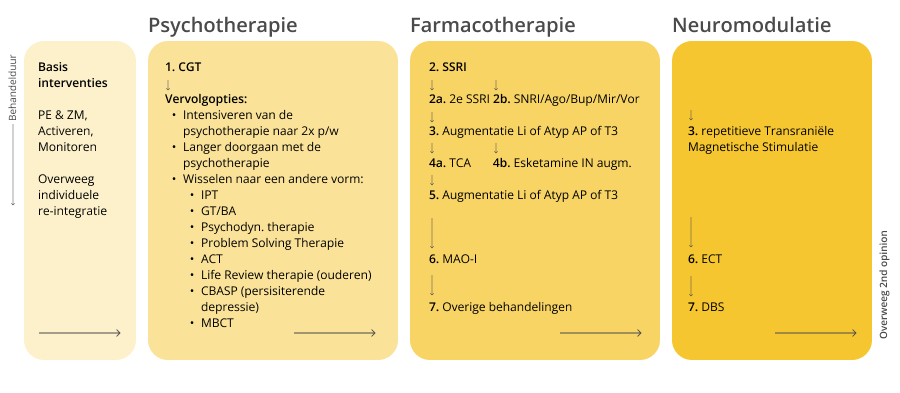
Mental health professionals follow established treatment guidelines, using evidence-based options in a careful and stepwise manner, tailored to your symptoms and treatment history. In many cases, treatment has already included psychotherapy and/or medication. When these approaches do not lead to sufficient improvement, additional or more specialized treatment options are considered, such as neuromodulation with rTMS. This is not a last resort, but a targeted next step within a broader treatment strategy.
Sometimes treatments are combined; in other cases, a different approach is chosen. Options may range from medication augmentation (such as adding lithium) to more advanced interventions such as rTMS, esketamine, EMDR, or in severe cases electroconvulsive therapy (ECT), often combined with intensive psychotherapy and psychosocial support to provide individualized care. What remains central is selecting the approach that best fits your specific situation.
Neuromodulation
When previous treatments have not led to sufficient improvement, neuromodulation may be considered as a next step. Neuromodulation focuses on influencing brain activity involved in depressive symptoms. A commonly used form of neuromodulation is rTMS, a treatment that targets and stimulates specific brain regions.
Why rTMS can be helpful
rTMS uses stimulation to specific brain regions involved in depressive symptoms. Because the treatment acts directly on the brain, systemic side effects are generally avoided. rTMS can be combined with psychotherapy or medication. Research shows that many people with treatment-resistant depression still experience meaningful improvement with this approach.
Practical considerations
Treatment sessions typically take place several times per week over a number of weeks. rTMS is not suitable for everyone, as certain medical factors may represent a contraindication. Some individuals experience side effects, such as mild headaches or discomfort at the site of stimulation. As with any treatment, results can vary from person to person.
What is rTMS?
rTMS therapy focuses on restoring balance in specific brain regions, without requiring anesthesia or surgery.
How it works
Our team specializes in treating depression and obsessive-compulsive disorder (OCD), combining rTMS with psychotherapy.
The effect of rTMS?
rTMS helps rebalance brain activity, leading to improvements that can remain noticeable in the long term.
Specialized care for depression
Treatment-resistant depression requires specialist knowledge and experience. At rTMS International, we focus specifically on complex treatment pathways. We do not only consider what has not worked so far, we focus on where meaningful options may still exist.
When previous treatments have provided insufficient relief, it can understandably create uncertainty. In that situation, it is important to receive care in a setting with experience in complex depression. We take the time to carefully explore which approach best fits your personal situation.
Careful assessment
In treatment-resistant depression, it is important not only to look ahead, but also to review what has been tried in detail. Which treatments were used? At what dosage? For how long? And what was the effect? We discuss openly and transparently what treatment at rTMS International may offer, and what it may not.
Take the step towards recovery
There is a treatment that works, even when previous therapies have not helped enough. Discover rTMS or ask a question.